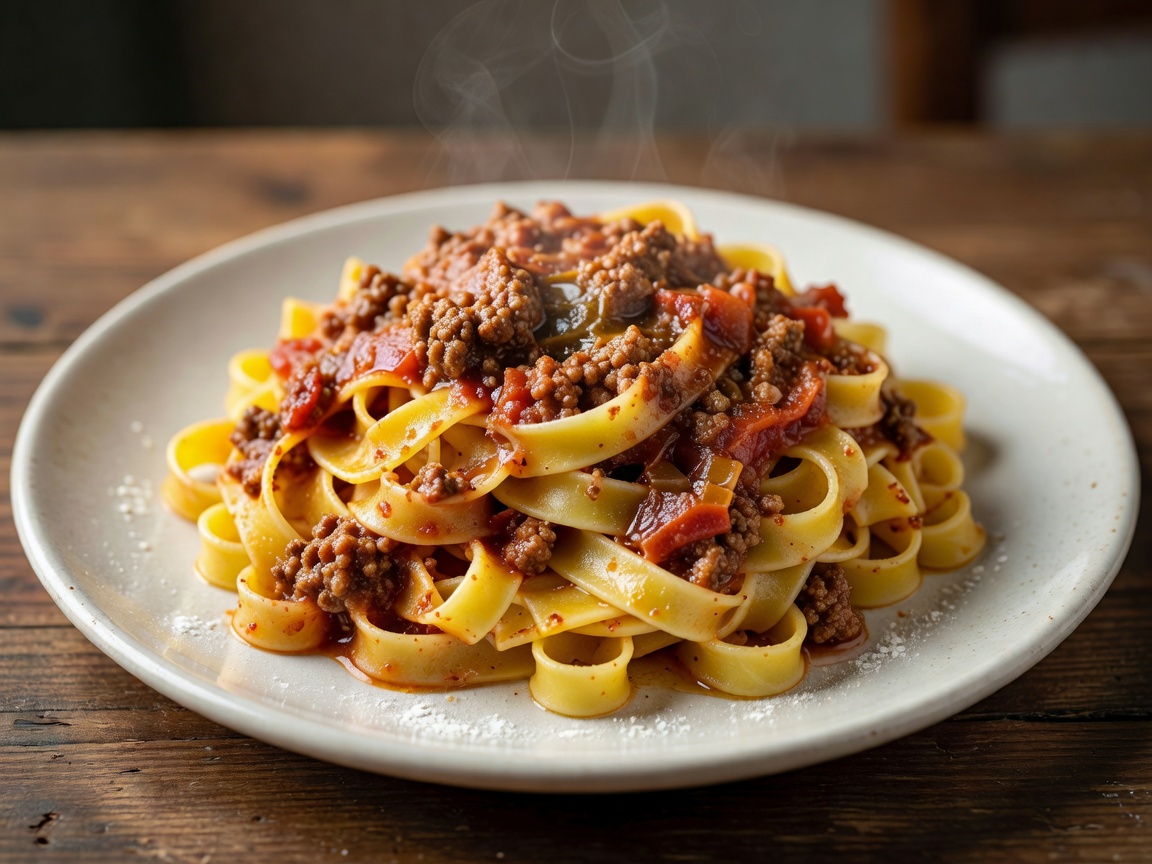
The Cultural Myth vs. Historical Reality
Across global restaurant menus, "Spaghetti Bolognese" has become ubiquitous. However, if you order this dish in the medieval heart of Bologna, you will receive a patient correction from any self-respecting oste. Spaghetti—a dry durum wheat cylinder originating in Southern Italy—cannot support the weight or cling to the emulsion of authentic northern ragù. The sauce simply slides to the bottom of the bowl.
In Emilia-Romagna, ragù belongs exclusively to broad, porous ribbons of fresh egg tagliatelle (strictly measured at 8 millimeters in cooked width, commemorating the height of Bologna's Torre Asinelli) or layered between fresh spinach pasta sheets for Lasagne alla Bolognese.
The Official 1982 Notarized Recipe
On October 17, 1982, the Italian Academy of Cooking (Accademia Italiana della Cucina) officially filed the notarized recipe for Ragù Bolognese at the Bologna Chamber of Commerce to protect the dish from worldwide degradation. The foundation relies on balanced fat chemistry and low-acid simmering:
- The Meat Base: 300g coarse-ground beef skirt or flank (cartella), paired with 150g unsmoked pork pancetta cured with black pepper.
- The Soffritto: Exactly 50g yellow onion, 50g celery, and 50g carrot, minced finely and sweated slowly in the rendered pancetta fat.
- The Deglaze: 100ml dry white wine (Trebbiano or Pignoletto), cooked down until dry.
- The Liquid Balance: 300g strained tomato purée (passata) and whole milk added in intervals to mellow the tomato's acidity and tenderize the muscle fibers.
- The Cooking Time: A strict minimum of 3.5 to 4 hours on the lowest possible flame, allowing the connective tissues to dissolve into natural gelatin.
The Chemistry of Milk in Ragù
A frequent surprise to modern home cooks is the mandatory inclusion of whole cow's milk. When milk is added during the early braising phase, the lactic acid gently tenderizes the coarse beef fibers without shredding them. Furthermore, the dairy proteins coat the tomato particles, producing the characteristic silky, orange-hued emulsification that clings perfectly to porous egg pasta without requiring heavy flour or cornstarch binders.
Top Osterias Serving Authentic Ragù in Bologna
- Trattoria di Via Serra (San Donato District): A pilgrimage site utilizing ancient Slow Food Presidium white cow beef and mountain flour doughs.
- Osteria Bartolini: Renowned for their ultra-thin sfoglia (hand-rolled pasta sheet) rolled with traditional wooden rolling pins (mattarello).
- All'Osteria Bottega: Chef Severino's temple to Emilia gastronomy, where ragù is simmered for over six hours.